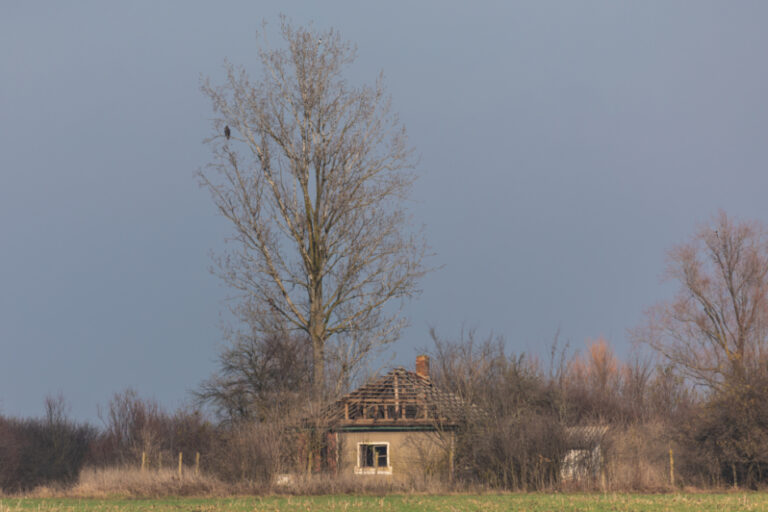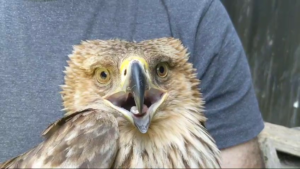







After the identification of the first nesting Eastern imperial eagle...
Read moreThe Eastern imperial eagle (Aquila heliaca) has been selected as the ENDANGERED SPECIES OF THE YEAR 2026. With your support, we will carry out field surveys to identify breeding pairs, locate nests and monitor breeding activity. This will be followed by targeted conservation actions, including the installation of artificial nests, nest monitoring with trail cameras and tree planting, which can provide suitable nesting sites for pairs in the long term.
Due to its extremely low population size, ongoing threats and the dramatic population decline recorded over the past hundred years, the Eastern Imperial Eagle is listed as Critically Endangered (CR) on Romania’s Red List of bird species.
The population continues to be affected by several major threats, most notably poisoning, electrocution caused by power lines, agricultural intensification, and the loss of old trees that can serve as nesting sites.
About the species
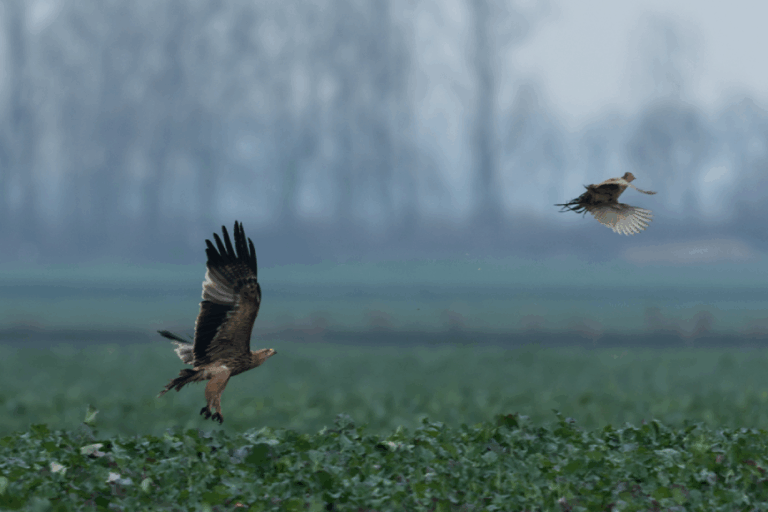
The Eastern imperial eagle is a large bird of prey. Adult individuals have dark brown plumage with distinctive white shoulder patches. Their wings are long and narrow, held straight or slightly drooping during soaring flight. Juvenile birds are lighter in colour, with sandy-toned plumage, and only attain the characteristic dark adult plumage by their sixth calendar year.
Its diet mainly consists of medium-sized mammals and birds, such as European hare, hamster, ground squirrel and pheasant, but carrion is also consumed, especially during winter. The Carpathian Basin population is largely resident, while young birds often undertake longer dispersal movements, primarily towards the Balkan Peninsula.
The species typically occurs in open landscapes with a mosaic structure, where extensive agricultural land alternates with grasslands and forest patches. For breeding, it selects areas that offer sufficient food resources and relatively low levels of disturbance.
Nests are usually built in large, solitary trees or trees located at forest edges. Old, stable trees are particularly important, as nests are often used for several consecutive years and regularly refurbished.
Our activities so far
In 2016, in Arad County, we successfully identified a breeding pair of Eastern Imperial Eagles, marking the first confirmed nesting of the species in Romania after a 45-year absence. Since then, we have monitored occupied territories on an annual basis and identified several breeding attempts.
Following the discovery of the first nest, the number of occupied territories and successfully breeding pairs gradually increased. This positive trend is largely attributable to decades of conservation efforts carried out by our colleagues in Hungary. As a result, the number of breeding pairs in Hungary has risen to over 300, and the species’ eastward expansion has reached Romania.
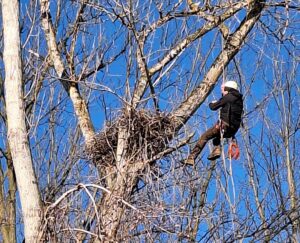
In 2024, we reinforced one damaged nest by increasing its stability with the help of a metal support.
That year, we recorded a record number of 9 occupied territories, documented 3 successful breeding pairs and 4 fledglings leaving the nests. Despite these encouraging results, in 2025 we were only able to identify the same 3 pairs that had bred the previous year, and we currently lack reliable data on their breeding success.
Before implementing the planned conservation measures, it is essential to assess the current population status of the species. This will be followed by concrete actions aimed at improving breeding conditions and increasing the number of breeding pairs nesting in Romania.
Citește mai mult:
We strengthened an Imperial eagle nest
The Eastern Imperial Eagle has suffered a significant decline worldwide...
Read moreBandi flies over Transylvania!

Bandi is the first Imperial Eagle in Romania monitored through...
Read more