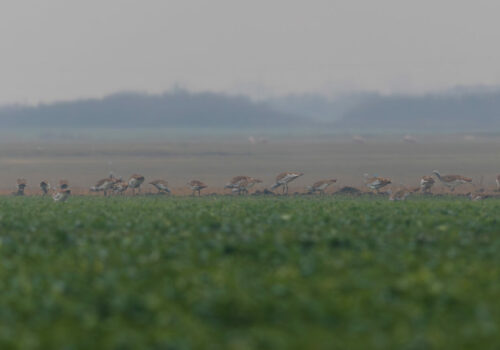
The sixth Synchronous winter count of the Great Bustard in Central Europe took place between 7 and 13 January. The survey was carried out using a synchronised counting method, meaning that experts conducted fieldwork in all regions on the same days in order to avoid double counting caused by the movement of birds between areas. Winter is the most suitable period for this type of survey, as Great bustards gather in large flocks, increasing the likelihood of detecting as many individuals as possible.
Even the challenging winter conditions helped this year’s census. The harsh weather encouraged Great Bustards to form even larger groups, while the widespread snow cover across almost the entire survey area, from Burgenland to the Crișana region, provided particularly favourable observation conditions.
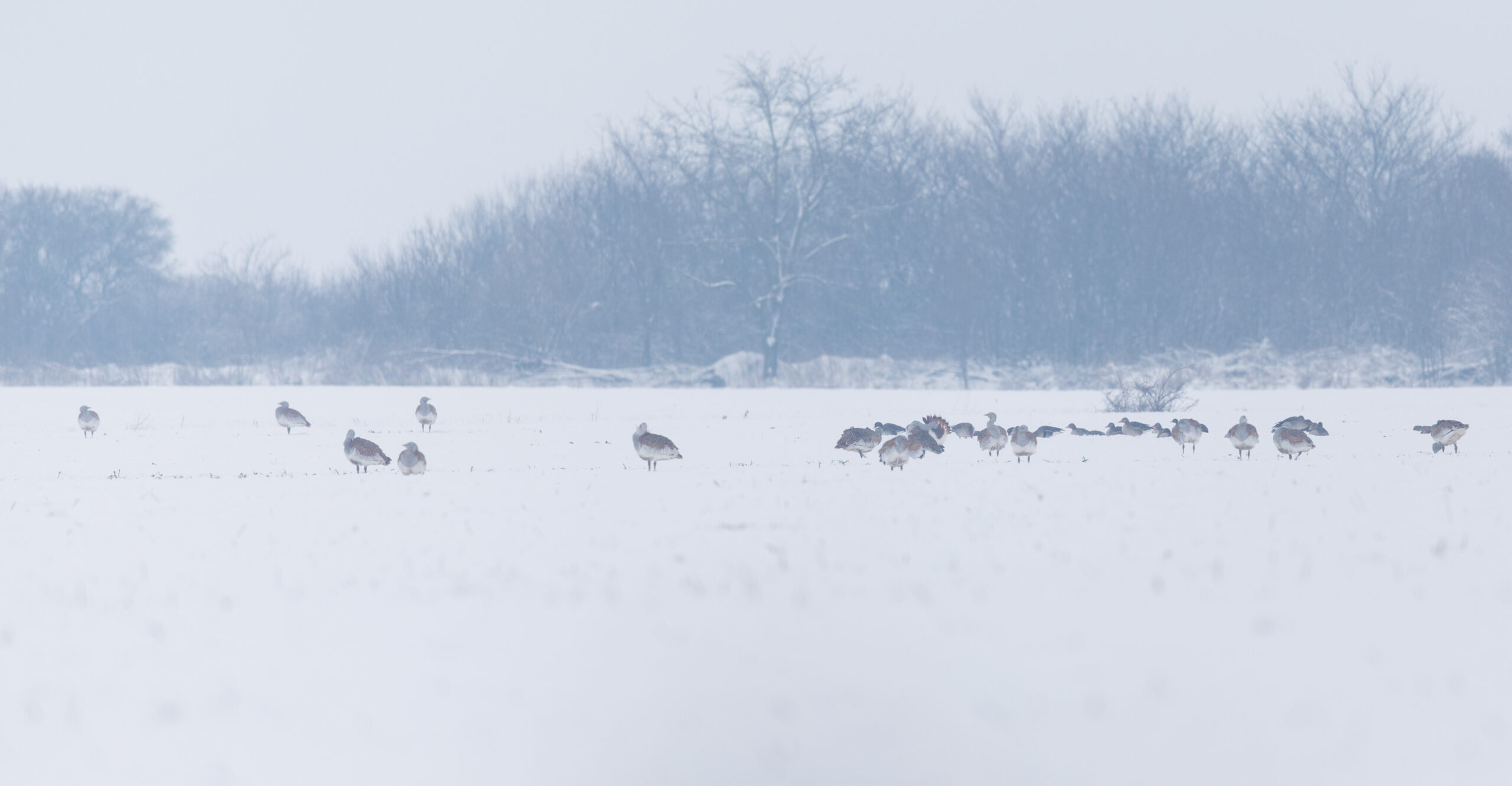
In the area around Salonta (Bihor County), the number of overwintering birds has been increasing in recent years, a trend that continued this year with a record count of 108 individuals. The sex ratio was nearly balanced, with 57 males and 51 females observed. The results were further strengthened by surveys carried out by experts from the Hortobágy National Park Directorate, who recorded an additional 40 Great Bustards near the border area of Girișu de Criș (Bihor County).
Within the Carpathian Basin, the so-called East Pannonian region remains the most important area for the species, including the habitats found in the Crișana. In this extensive region, which largely encompasses Great Bustard habitats east of the River Tisza, a total of 1,740 individuals were recorded this January. This represents an increase of around 400 birds compared to the 2025 figures. The notable difference may partly be explained by the movement of larger flocks from other regions, such as the Danube Plain between the Rivers Danube and Tisza.
Overall, a significant increase was also observed across the entire Carpathian Basin. In January, at least 2,992 Great bustards were recorded, representing an increase of approximately 10% compared to the 2025 census. These results clearly indicate that the Great bustard population in the Carpathian Basin is steadily growing and continues to show a positive long-term trend.
This long-term maintenance of favourable population trends is also supported by the LIFE EUROBUSTARD project, launched in December 2024. The “Cross-border protection of the Great Bustard and the Little Bustard” is being implemented by 30 partners from eight countries and aims to halt the further decline of European populations of these two species. Within the project, the Milvus Group will work to conserve the last remaining Great bustard habitats in Romania, located in the Salonta area.