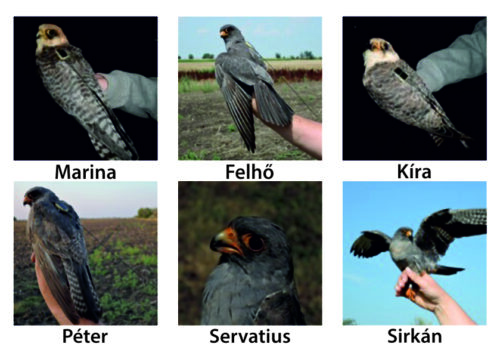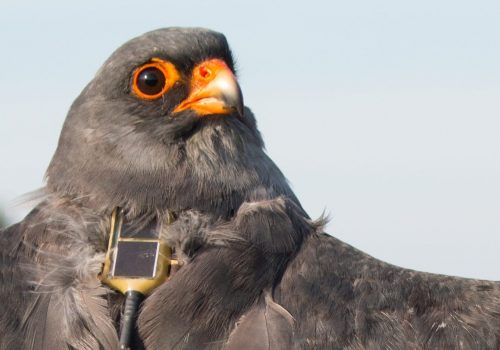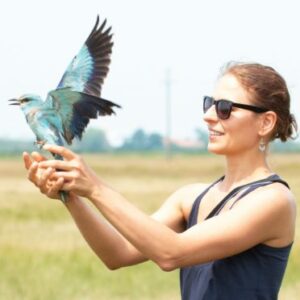
The Red-footed falcon is one of those species we have been closely monitoring for many years, as it is listed as Vulnerable on the IUCN Red List of Vulnerable Species.
This falcon is a social bird, not only breeding in colonies but also gathering in small or large groups during migration and at its African wintering grounds. Between the breeding season and autumn migration, the falcons prepare for their long journey of several thousand kilometres. During the day, they feed continuously to build up fat reserves for the exhausting trip ahead, while at night they roost in small groups of trees on the steppe—often near breeding colonies, alongside individuals that have not yet departed.

Monitoring these roosting sites is one of our longest-running programmes, launched in 2006 as part of a Hungarian–Romanian LIFE project for the conservation of the Red-footed Falcon. Each year, we visit these traditional roosting sites, many of which are used by the falcons year after year. One such site is a gathering place in the Banat region, where we first counted the birds in the autumn of 2008, and where, 17 years later, the falcons still return—just as we do. Who knows how long they had been using it before we discovered it?
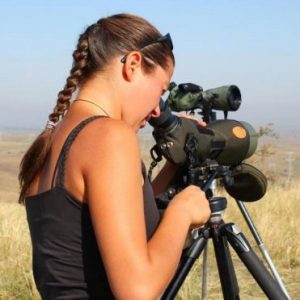
The synchronous count of the Red-footed falcons, covers almost the entire Carpathian Basin. On average, simultaneous counts are carried out at 40–50 observation points across Hungary, Romania, Slovakia, and Serbia. This year, from the second half of August until early October, observers conducted weekly counts at the usual roosting sites for seven consecutive weeks, avoiding possible double-counting caused by the birds’ movements.
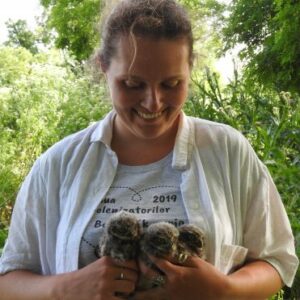
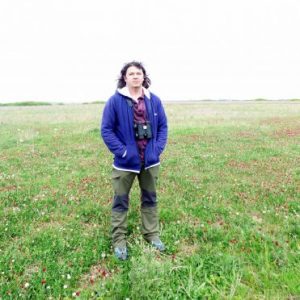
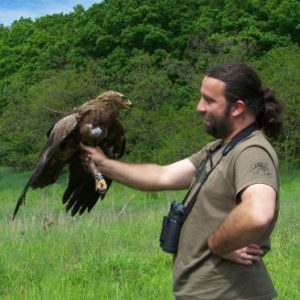
Staff and volunteers of the Milvus Group monitored five long-known gathering sites this year—one in Bihor County, two in Arad County, and two in Timiș County.
Results of this year
Across the entire monitored area, a record number of falcons was counted—exceeding 20,000 individuals. In Hungary, the largest concentrations were observed in the Hortobágy and Kiskunság regions; at one of the Hortobágy roosting sites, observers estimated around 5,000 Red-footed Falcons for two consecutive weeks.
In contrast, in Romania—particularly in Crișana and Banat—the birds gathered in smaller numbers than usual. The most significant result came from a roosting site in Arad County, where during the mid-September peak we counted close to one thousand individuals.

This year also differed from the usual pattern: the northern flocks did not shift towards the southern Banat roosts once migration began, but most likely followed a more westerly route, along the River Tisza and across the area between the Danube and Tisza rivers.

Next year, we will once again count the Red-footed falcons, but until then we hope that as many as possible will reach their African wintering grounds safely. We also wish our Hungarian colleagues success in their ongoing efforts to protect the species’ major spring gathering sites in Angola. Those who can are encouraged to support their work!
We would like to thank all those who assisted the Milvus Group by taking part in this year’s synchronous counts in Crișana and Banat: Diana Ardelean, Buslig Johanna, Theodora Chirilă, Ana-Daniela Ciocan, Alexandros Dimcea, Bărbos Bálint, Bărbos Berce, Bărbos Lőrinc, Mircea Brăban, Karina Bronț, Hanna Diaconescu, Larisa Gavagina, Jazbinszky Erik, Eugeniu Lițcan, Marton Attila, Vlăduț Monenci, Silviu Mureșan, Nagy Attila, Tania Oprin, Milca Petrovici, Ștefan Popa, Alexandru Rădac, and Ionela Rădac.