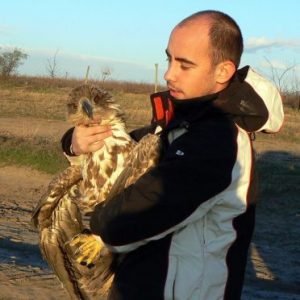
It is far easier to preserve what we have than to rebuild what we have destroyed. A clear example of this is the population of Saker falcons.
Although the species was present in considerable numbers in the Western Plain of Romania until the beginning of the 20th century, hunting, poisoning, and the disappearance of solitary trees led to the Saker falcon no longer breeding in this part of the country.
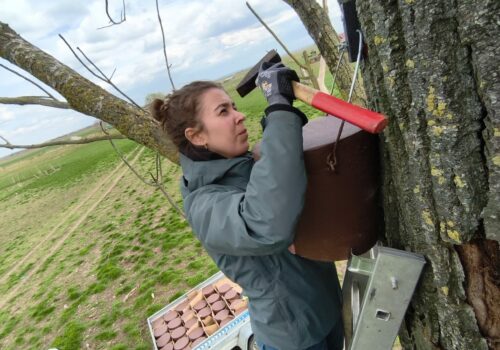
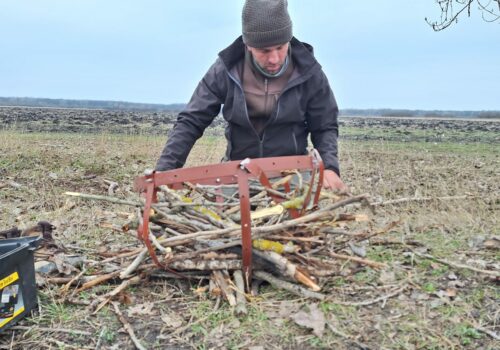
As Saker falcons do not build their own nests but instead occupy those of other birds of prey, between 2013 and 2014 we installed 80 artificial aluminium nests on high-voltage electricity poles through a LIFE project funded by the European Union. We also insulated several pylons to reduce the risk of electrocution.
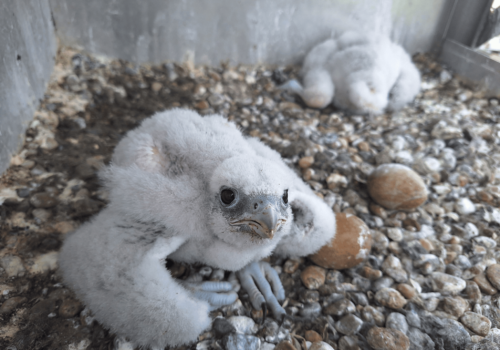
These conservation measures gradually began to produce results. The number of artificial nests occupied by breeding pairs of Saker falcons increased year by year, and the first chicks soon appeared.
Each year, we inspect the artificial nests mounted in Bihor, Timiș, Arad and Satu-Mare counties and monitor the progress of the breeding season. The video offers a glimpse into a day of fieldwork in Arad County.
Last year, we reported a record 48 breeding pairs and a record 140 chicks successfully raised.
This year, we achieved even better results: of the 53 pairs that occupied a nest, 47 bred successfully and raised a total of 159 chicks. As in 2025, only a single pair used a natural nest, which had been built on a high-voltage electricity pylon.
Another piece of encouraging news is that we recorded the first successful nesting in an artificial nest installed in Satu Mare County. The pair in question raised no fewer than five chicks.